


In a music world that often prefers polish over peril, Coma Beach remain uncompromising architects of chaos, weaving an experience that is as unsettling as it is captivating. Their latest EP, A Madman’s Dream/Mind Descending, is not merely a release—it is an excavation of madness, a hallucinatory descent into the fractured psyche of an unnamed antihero whose story has haunted the band’s discography for three decades.
Formed by singer B. Kafka, guitarist Captain A. Fear, bassist U. Terror, rhythm guitarist M. Blunt, and drummer M. Lecter, Coma Beach stand as prophets of discomfort. Their music doesn’t seek to soothe; it aims to pierce, provoke, and leave the listener altered. Kafka’s vocal delivery channels the tormented depths of existence, at once prophetic and pained. Fear conjures catharsis from guitar strings like a shaman casting spells, while Lecter’s drums strike with the inevitability of a ticking clock counting down to collapse. Together with Terror’s subterranean bass and Blunt’s rhythmic anchors, the band craft sonic landscapes that are both brutal and strangely beautiful.
Their influences span the raw fury of the Sex Pistols and Ramones, the melancholy resonance of Joy Division and The Cure, and the feedback-soaked dreamscapes of The Jesus and Mary Chain. But Coma Beach never settle for imitation. They stitch swagger from Guns N’ Roses, philosophical bite from Bad Religion, and introspective grit from Therapy?, creating an identity that is distinctly their own—a volatile tightrope between punk urgency and alternative nuance.
“A Madman’s Dream/Mind Descending” is the second installment in the band’s Scapegoat Revisited EP triptych, celebrating the 30th anniversary of their 1995 debut album, The Scapegoat’s Agony. That original work introduced the tormented antihero whose journey through madness, despair, and defiance has become the band’s mythos. By revisiting these tracks in new forms, Coma Beach are not only honoring their past but also reimagining it for a world that still struggles with the same existential wounds.
The title itself nods to Samuel Beckett’s Waiting for Godot, an allusion that signals the band’s literary and philosophical undercurrents. Just as Beckett stripped human existence to its absurd essence, Coma Beach expose the raw nerves of psychological collapse, social disillusionment, and spiritual futility.
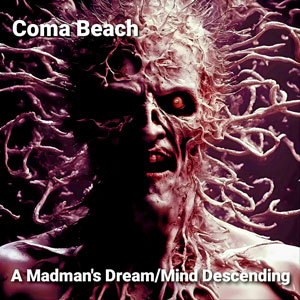
The EP opens with “A Madman’s Dream – Single Version”, a tightly coiled alt-rock assault that embodies the antihero’s harrowing breakdown. Shorter than the album version, this track wastes no time plunging listeners into confinement and despair. Its lyrics are stripped lean, constructed from sharp, repetitive couplets that echo like a nightmare nursery rhyme: brain/pain/insane/vain. The effect is claustrophobic, a mantra of madness that reinforces the inescapable grip of psychological torment. It is a song that doesn’t simply describe breakdown—it enacts it.
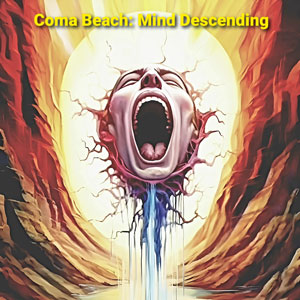
Its twin, “Mind Descending – Single Version”, follows with a rawer, more confessional tone. Where A Madman’s Dream portrays the crushing inevitability of collapse, Mind Descending feels like a fractured memoir—a stream of contradictory, surreal images that trace the very genesis of insanity. Kafka’s vocal delivery here is particularly effective, shifting between urgency and disorientation, while the band’s abrupt tonal changes mimic fractured thought patterns. The result is a dizzying, surreal descent that leaves the listener unmoored.
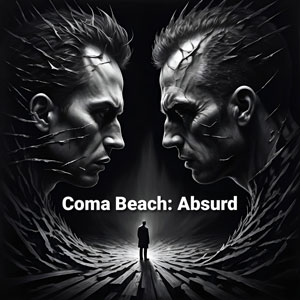
The EP’s midpoint shifts from the personal to the political with “Absurd”. Originally track #10 on The Scapegoat’s Agony, its radio edit appears here as a manifesto of nihilistic cynicism. Where earlier tracks explore internal collapse, Absurd aims outward, skewering society’s hypocrisies, shallow rituals, and empty convictions. Stripped of ornamentation, the lyrics burn with direct condemnation, giving the track a venomous punk edge even as it unfolds in a slower, almost balladic framework. It is both accusation and rejection—a sneer at a world the antihero refuses to validate.

From there, “I Won’t Listen” takes the antihero’s disdain to its most confrontational form. First appearing on a 1995 demo, this track has aged into a vicious anthem of aggressive apathy. It is not just about boredom or alienation—it is about weaponizing indifference into a philosophy of total withdrawal. The EP’s radio edit distills that hostility into its sharpest form, creating a song that feels both exhilarating and suffocating. In its refusal to engage, the track paradoxically commands full attention.
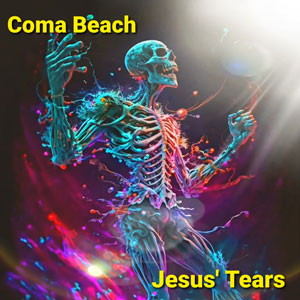
Closing the EP is “Jesus’ Tears – Radio Edit”, one of the band’s most powerful and infamous tracks. Here, the antihero’s delirium takes on biblical proportions. He imagines himself undergoing a Christ-like crucifixion, promising vengeance even as he succumbs to despair. It is a song steeped in sacrilege, blending sacred imagery with profane fury: angels, crosses, spitting, blood. The effect is devastating, as Kafka delivers each line with theatrical intensity, elevating personal suffering into allegory. The song does not offer redemption—it ends in unholy martyrdom, a fittingly ferocious climax to both the EP and the antihero’s narrative arc.
In an era when much of rock has been tamed into nostalgia or neatly packaged rebellion, Coma Beach stand defiantly raw. They are not interested in comfort or compromise. Instead, they confront listeners with the bleak truths of existence—madness, futility, alienation, rage—and insist that these are not just private agonies but shared human conditions.
A Madman’s Dream/Mind Descending reminds us that madness is not a distant pathology but a mirror, reflecting what happens when meaning falters and the structures of society reveal their absurdity. It is music that demands more than passive listening—it demands immersion, confrontation, and perhaps a little self-recognition.
Three decades after The Scapegoat’s Agony, the antihero still wanders, rages, and collapses, his story as relevant as ever. By revisiting him now, Coma Beach have not only honored their past but sharpened it into something vital for the present.
With this EP, the band prove that chaos, when harnessed with conviction and vision, can still cut through the noise of the modern world—and that madness, when sung with truth, can be strangely clarifying. Coma Beach – A Madman’s Dream/Mind Descending is not an easy comfy-couch listen. It isn’t meant to be. It is a descent, a reckoning, and ultimately, a challenge: to look into the abyss, and perhaps to hear it sing back.
OFFICIAL LINKS:
https://twitter.com/ComaBeach42
https://www.facebook.com/comabeach/
https://www.instagram.com/coma.beach/
https://www.threads.net/@coma.beach
https://bsky.app/profile/comabeach42.bsky.social
https://www.tiktok.com/@coma.beach
https://youtube.com/channel/UCfxMPinw4RlvwSS6yFxJUog/
https://distrokid.com/hyperfollow/comabeach/the-scapegoats-agony-2/











Leave a Reply